This map guide covers all MECCHA CHAMELEON maps, including the best hiding spots and hunter routes for each stage. The map you are playing on decides your color palette, your hiding options, your escape routes, and how hard the hunters have to work. A great painter on a bad map can still lose. A beginner who understands the map can survive with a messy paint job.
This guide covers every official map currently available, the best hiding approaches for each one, and how hunters should think about searching them. It is written for both hiders and hunters, from first-time players to groups trying to organize better friend lobbies.
1. Why the Map Is the Real Game
Before you pick up your brush, the map has already made most of your decisions for you. It decides:
- Which colors are available to copy
- How much visual clutter there is to hide inside
- Where the shadows fall and how forgiving they are
- How much vertical space you can use
- How easy it is to move if a hunter gets close
- How many players the map feels right for
A player who understands the map will usually beat a player who only understands the paint menu. The reason is simple: hiding is about context. The best paint job in the world means nothing if you are standing in the wrong place.
Three Map Archetypes
Almost every official map falls into one of these three patterns. Knowing the pattern tells you what kind of hiding plan works best.
| Type | Examples | What It Rewards | Main Risk |
|---|---|---|---|
| Visual-noise maps | Backrooms, Sewer, Hide-and-Seek Mansion | Rough paint jobs, cluttered silhouettes, blending into garbage and furniture | Hunters can learn to read the noise |
| Big-color-block maps | Indoor Country, Sugar Land, Penguin Hotel | Strong color matching, posing, looking like an object | Bad color matching is instantly visible |
| Structural maps | Osaka | Height, angles, signage, architectural edges | Little clutter means mistakes stand out |
If you treat every map the same way, you will lose rounds you should have won. The first step is to recognize what the map is asking you to do.
2. How to Approach Any Map as a Hider
There is a repeatable process that works on every map. Going through it in order will save you time and improve your survival rate.
Step 1: Pick a Region Before You Start Painting
Do not start painting and then look for a spot. Decide where you want to be first. Ask yourself:
- Is this map big enough that hunters will not reach me quickly?
- Is there a shadow I can use?
- Is there clutter or texture that hides imperfect painting?
- Is there a nearby escape route if I need to move?
- Can I get a good angle from the hunter's likely path?
Step 2: Choose a Pose Before You Paint
Your pose changes what colors are visible and how your body reads as a human shape. Common choices:
- Crouching — hides height, works under objects
- Lying flat — best for ground textures, floors, carpets
- Standing against a wall — classic flat-wall hiding
- Sitting — great for plushies, chairs, benches
- Arms raised or contorted — breaks the human silhouette
Try the pose before you paint. Sometimes a small pose change makes a terrible color look good, or vice versa.
Step 3: Use the Eyedropper, Then Adjust
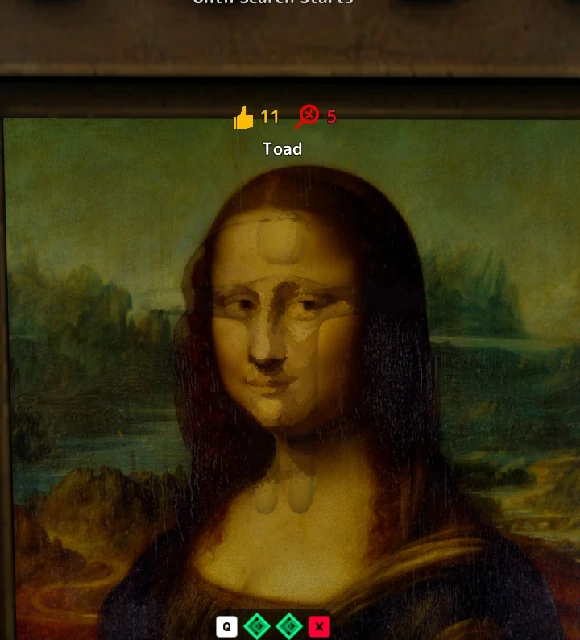
The eyedropper is the fastest way to match the base color of a surface. But the exact color is rarely the right color. You usually need to:
- Go slightly darker if you are in shadow
- Go slightly brighter if the light is hitting you
- Shift hue to match the camera's angle, not just the wall's surface
- Pick multiple colors if your body crosses different textures
A common beginner mistake is copying one color and calling it done. Good hiders layer colors.
Step 4: Expand Your Brush and Cover Big Areas Fast
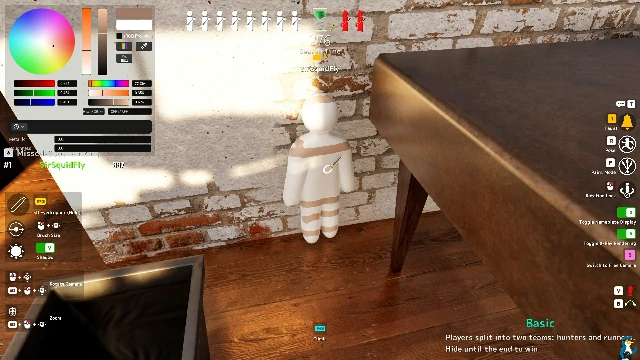
You can resize the paint brush by holding the right mouse button and moving left or right. When the timer is running down, use the largest brush size you can and cover the biggest body parts first. You can always refine details while waiting for hunters.
Step 5: Break Your Silhouette and Use Height
Players rarely look up. A body on a ceiling beam, sign, or upper floor is already halfway hidden. Even on ground level, break your silhouette by putting objects in front of you or posing to look less like a person.
Step 6: Be Willing to Move
Moving is scary, but it is one of the most powerful tools. If a hunter is nearby and you have a second spotted, move when their attention is elsewhere. The key is to pick your next spot before you leave your current one, and to be able to repaint fast.
Step 7: Hide Well, But Not Too Well
This is the most advanced idea. You gain points when hunters see you but do not notice you. The ideal spot is visible enough to rack up points but not obvious enough to get caught. This is why middle-distance spots, partial shadows, and "hunters walk past it" locations are often better than deep corners.
3. Every Official Map Explained
There are currently seven official maps in MECCHA CHAMELEON. Each one has its own hiding culture, difficulty, and best practices.
Backrooms
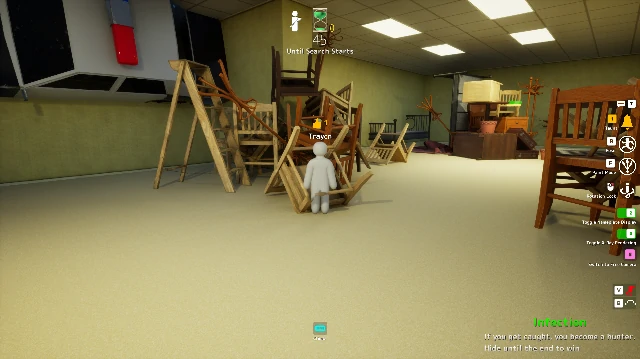
The Backrooms map is a tribute to the classic internet horror aesthetic: yellow wallpaper, empty office rooms, scattered furniture, and lots of random objects. The lighting is flat and strange, which makes color matching both easier and more deceptive.
This is a visual-noise map. The clutter is your friend. You do not need a perfect paint job. You need to look like another piece of the mess.
Environment breakdown:
- Off-yellow wallpaper and carpet
- Office cubicles and desks
- Furniture stacks, chairs, ladders, and drawers
- Trash corners and garbage piles
- A birthday-party hallway with cakes and balloons
- A broken highway area with police cars
- A vending-machine area
Recommended hider strategies:
- Hide inside clusters of living chairs, ladders, and drawers. The gaps and shadows between objects break your silhouette.
- Use corners with trash thrown against the wall. Blend in with the garbage and let the noise do the work.
- Try the office cubicle corners. They are tight but can be excellent if you match the yellow tones.
- In the birthday-party hallway, disguise as a balloon or hide among the chairs. The bright colors are forgiving because the area is already visually chaotic.
- In the broken highway area, hide under police-car lights or alongside the vehicles. The dark metal and red/blue lights can cover imperfect paint.
- On the bottle-cap wall, lie flat or stand against the texture. The busy pattern hides mistakes.
- Use the vending machine from a careful angle. Watch your side profile so you do not stick out.
Advanced tip: The best Backrooms spots are often in the middle of clutter rather than in corners. Hunters expect corners, but they walk past piles of chairs without really looking at every object.
Hunter search plan:
- Start with the furniture stacks. Players love to stand between objects.
- Check the office corners and cubicles.
- Walk through the trash piles slowly. Look for a shape that is too round or too tall.
- Check the birthday hallway and broken highway last, but do not skip them.
- Listen for movement after Forced Taunt.
Hide-and-Seek Mansion
The Mansion is a large, busy map with a main ballroom, a full library, a kitchen, a laundry room, storage areas, and side rooms. It is one of the most visually rich maps, which means many options but also many places for hunters to learn.
This is a hybrid map. Some areas are pure clutter, and others are clean color blocks. You need to read each room separately.
Environment breakdown:
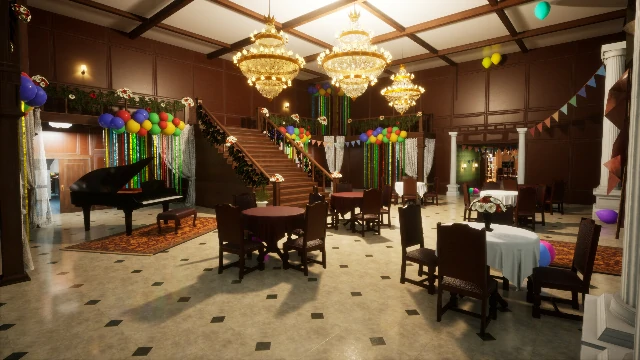
- Main ballroom with balloons, chairs, pillars, and statues
- Library with bookshelves, chairs, and dark walls
- Kitchen with posters, shelving, and meat props
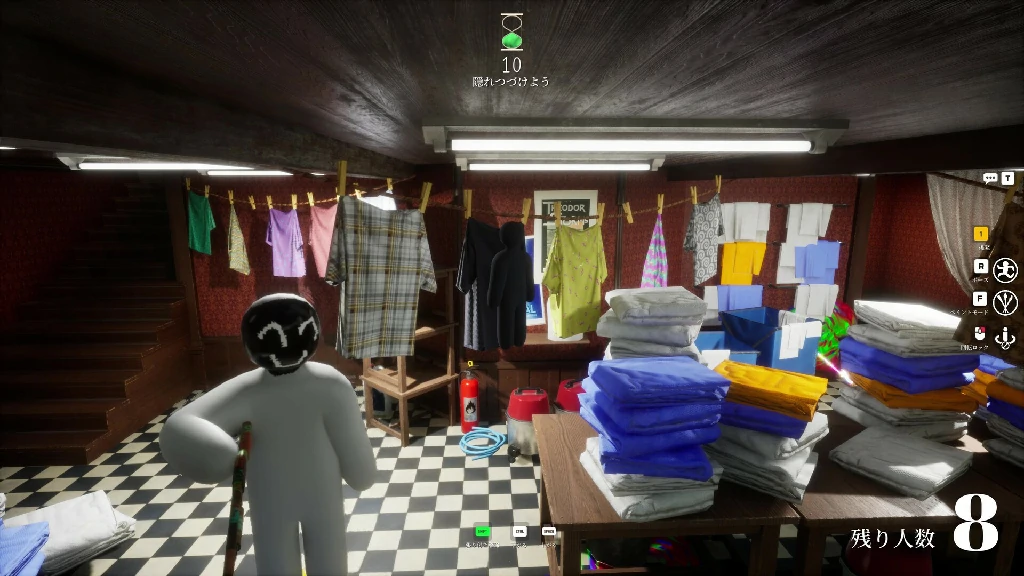
- Laundry room with towels, machines, and tables
- Storage area with vases, loose furniture, and trash
- Hallways with paintings and wooden arch walls
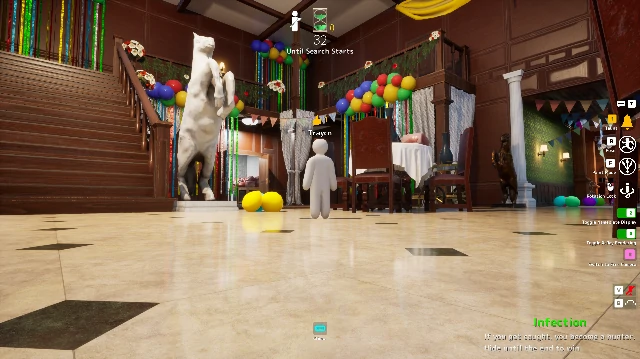
Recommended hider strategies:
- In the library, hide among the bookshelves, crouch as a book, or slide under a chair against the dark wall.
- In the main ballroom, hide on the ceiling beams, among the balloons, or as one of the pillars.
- In the kitchen, paint yourself to match a poster, hide as a meat hunk, or crouch inside a shelving unit.
- In the laundry room, get on the tables next to the towels, or paint against the laundry machine.
- In the storage area, use vases, loose objects, and mixed furniture.
- In the hallways, mimic one of the wooden arch walls or a painting frame.
- The ceiling lip of the ballroom is a classic high-percentage spot.
Advanced tip: The Mansion rewards creativity. Players have hidden as statues, paintings, food items, and ceiling fixtures. If you can make hunters ask "is that supposed to be there?" you have a chance.
Hunter search plan:
- Clear the ballroom quickly but carefully. Look up at the beams and balloons.
- Search the library and kitchen next. These are common high-value spots.
- Check the laundry room and storage for obvious silhouettes.
- Walk the hallways last, looking for wrong frames or wooden textures.
Indoor Country
Indoor Country is a smaller, farm-themed map. It replicates a barnyard indoors with cow standees, horse statues, hay bales, pumpkins, and green crates. It feels more open than the Mansion, but there are still strong hiding spots.
This is a big-color-block map. You need to match objects, walls, and floors. The open space makes bad paint very visible.
Environment breakdown:
- Barn walls and fences
- Cow and horse standees
- Hay bales, pumpkins, and green crates
- A pumpkin patch
- Mud and dirt ground
- Balloons around the ground
- A cloud area near the ceiling
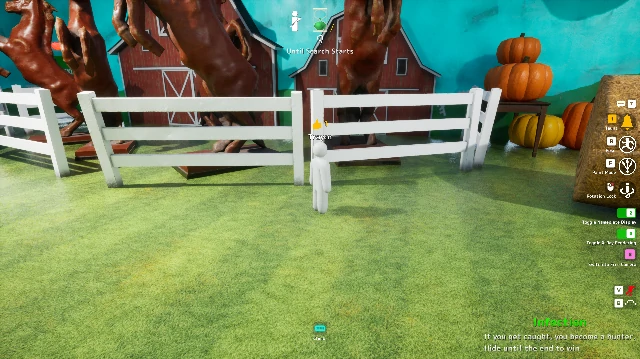
Recommended hider strategies:
- Stand along the side of the barns, in a spot that is blocked from direct view by hay bales, cow signs, or pumpkins.
- Perch on a cow standee and paint yourself like a cow.
- Wiggle into the pumpkin patch and pretend to be a smaller pumpkin.
- Hide inside or against the hay-bale pile.
- Hide among the ground balloons, but stay in the middle so you do not stand out.
- Use the mud on the ground. Pattern your paint to match a dirty patch with lots of surrounding objects.
- Blend against the horse statues or use fallen standees.
- Try the cloud area near the ceiling.
Advanced tip: Indoor Country is small, so hunters can clear it quickly. The best hiders use movement and misdirection. Hide in one place, let the hunter pass, then relocate to a spot they already checked.
Hunter search plan:
- Check the cow standees and horse statues immediately.
- Walk the pumpkin patch and hay-bale pile.
- Look along the barn walls for shapes that do not match.
- Do not forget the ground balloons and cloud area.
Osaka
Osaka is the newest and smallest official map. It is a city-block style environment with shops, trucks, signs, and a large octopus decoration. Because the map is compact, every hiding spot is riskier, but creative players can use the height and signage well.
This is a structural map. There is little clutter, so precision matters. You must match surfaces, use angles, and exploit height.
Environment breakdown:
- A large truck and open truck bed
- Signs above the street
- A large octopus statue and smaller octopus figures
- Open shop walls with metal fans and crates
- Trash piles and trash bags
- Walled corners with plywood and crates
- A trash can
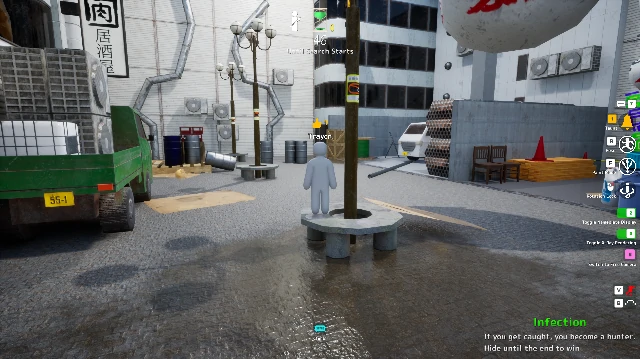
Recommended hider strategies:
- Hide in the truck bed or under the truck, matching the shadow carefully.
- Hide behind or beside the signs above the street.
- Blend against the octopus wall or lie near the downed statues.
- Paint to match the metal fans, crates, or storefront textures on shop walls.
- Pretend to be a trash bag in a pile.
- Use walled corners with plywood, crates, or extra trash bags.
- Try the trash can. It is risky but funny when it works.
Advanced tip: Osaka punishes lazy hiding. Because the map is small, you cannot rely on hunters missing you. You need to either hide high, match a key surface perfectly, or move.
Hunter search plan:
- Look up immediately. Signs and the octopus statue are the most common hiding spots.
- Check the truck bed and under the truck.
- Walk the shop walls and look for texture mismatches.
- Kick or inspect trash piles and corners.
Penguin Hotel
Penguin Hotel is a mansion-like hotel decorated with penguin plushies, balloons, statues, and furniture. It has a main ballroom, an upper floor, side rooms, and connecting hallways. The visual theme is strong, so matching the right colors is important.
This is a big-color-block map with a strong theme. The best hides look like they belong to the hotel decor.
Environment breakdown:
- Main penguin ballroom with plushies, balloons, statues, and furniture
- Upper floor with tables, statues, and large dice blocks
- Side room full of penguin plushies
- Bedroom side room with bed, bathroom, and desk
- Hallways between rooms
- White banners
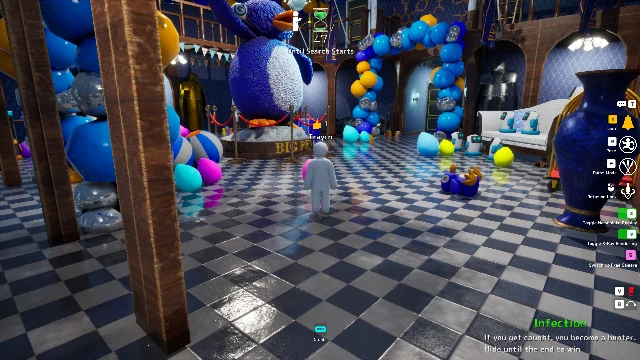
Recommended hider strategies:
- Hide among the balloons, penguin plushies, statues, or on the ceiling lip in the ballroom.
- On the upper floor, use tables, statues, and large dice blocks.
- In the plushie room, sit backwards and paint the back of your head to match the toys.
- In the bedroom, hide under the bed, in the bathroom, or against the desk.
- Use the hallways and their color transitions.
- The white banner is a strong option. It is out of direct line of sight and does not require perfect painting.
Advanced tip: The penguin theme is so strong that players who look like part of the decor survive longer than players who hide in dark corners. If you can become a "penguin object," you are harder to spot than a generic wall-hider.
Hunter search plan:
- Check the upper floor and the plushie room first.
- Walk through the main ballroom, looking for shapes that do not fit the decor.
- Check the bedroom and bathroom.
- Walk the hallways carefully.
Sewer
The Sewer map is dark, underground, and full of trash, graffiti, pipes, and open walkways. The poor lighting is a real advantage for hiders, but many spots are out in the open.
This is a visual-noise map with strong lighting tricks. The dark areas forgive mistakes, but the open areas expose you.
Environment breakdown:
- Central area with large canisters, trash bins, and sandbags
- A tea-pot area with off-color lighting
- A large locker room with lockers and drawers
- A partially flooded area with bins, concrete blocks, and graffiti
- Gas barrels and vending machines in open areas
- Ceiling pipes
- Sewer muck and chairs along the muck
- Graffiti walls
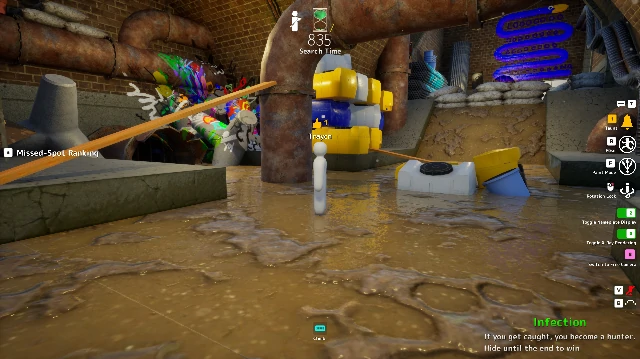
Recommended hider strategies:
- Hide in the central area with large canisters, trash bins, and sandbags.
- Use the tea-pot area and its off-color lighting.
- Hide inside lockers or open drawers in the locker room, using the overhead light.
- Use the flooded area with bins, concrete blocks, and graffiti.
- Hide near the gas barrels and vending machines.
- Stick to the ceiling pipes if you can manage the angle.
- Hide under the board in the sewer muck without entering the darkest shadow.
- Use the chairs along the muck, away from main pathways.
- Graffiti walls are forgiving. Even a rough match works because of the noise.
Advanced tip: Sewer rewards players who understand the lighting. A dark corner is safer than a bright one. If you can paint to match the shadow gradient rather than the wall, you become much harder to see.
Hunter search plan:
- Move slowly. The lighting hides both you and the hiders.
- Check the locker room first.
- Walk the flooded area and inspect the graffiti walls.
- Look up at the pipes.
- Use sound and Forced Taunt when the map gets quiet.
Sugar Land
Sugar Land is a bright, colorful candy-themed map. It has gingerbread houses, candy mountains, chocolate hills, cake structures, and gumdrop piles. The colors are fun, but the bright lighting makes bad paint jobs very easy to spot.
This is a big-color-block map with very bright lighting. There is nowhere to hide in shadow, so your color and pose must be correct.
Environment breakdown:
- Candy houses next to the chocolate hill
- Chocolate fountains
- A circle of gingerbread men
- Gumdrop piles in the center
- Candy mountain with shadows and vertical lines
- A white cake and tree area
- A taller locker in the corner
- More gingerbread houses on the side
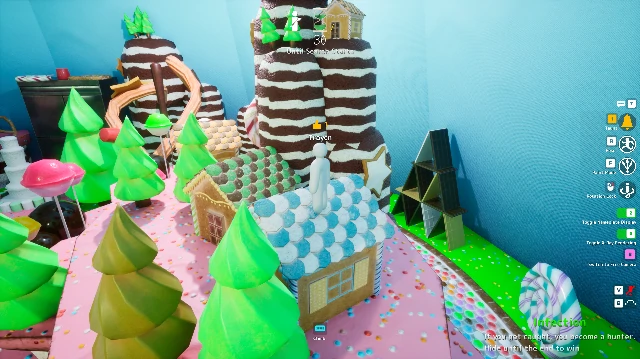
Recommended hider strategies:
- Hide in the candy houses next to the chocolate hill. Use height if you can.
- Match the chocolate texture at the fountains and hide next to something to block side views.
- Lie flat in the gingerbread-man circle among the other figures.
- Hide in the gumdrop piles in the center.
- Align against the candy mountain shadows and use the vertical lines on the cakes.
- Hide under the tree branches or as a strawberry on top of the white cake.
- Use the taller locker in the corner.
- Hide on top of or between the side gingerbread houses.
Advanced tip: Sugar Land is the least forgiving map for messy painting. The best approach is to pick one large color block and match it cleanly. Multi-color attempts usually fail because the bright light makes every edge visible.
Hunter search plan:
- Bright colors expose mistakes. Look for limbs that do not match the candy texture.
- Check the cake/tree area and chocolate fountains.
- Walk through the gingerbread-man circle and gumdrop piles.
- Look up at the candy houses and lockers.
4. Map Difficulty and Group Size Guide
| Map | Beginner Friendly | Recommended Players | Main Challenge | Best For |
|---|---|---|---|---|
| Backrooms | ★★★☆☆ | Medium to Large | Lots of clutter; hard to pick out shapes | Messy, creative hides |
| Hide-and-Seek Mansion | ★★★★☆ | Large | Big map with many rooms; easy to miss people | Big groups, long rounds |
| Indoor Country | ★★★★☆ | Small to Medium | Open farm set; relies on matching large objects | Beginners, quick rounds |
| Osaka | ★★☆☆☆ | Small to Medium | Small map; vertical hiding and precision matter | Skilled players, intense rounds |
| Penguin Hotel | ★★★☆☆ | Medium to Large | Strong theme; must match specific colors | Theme-based creative hides |
| Sewer | ★★★☆☆ | Medium to Large | Dark lighting; open walkways and lockers | Players who understand shadows |
| Sugar Land | ★★☆☆☆ | Small to Large | Bright lighting; bad paint is very visible | Players who can match colors well |
5. Map Selection by Game Mode
Different modes change how each map plays. Picking the right map for the mode makes the lobby more fun and balanced.
Basic Mode
Basic is the classic hunter-vs-chameleon mode. It works on every map, but some are better for learning:
- Best for beginners: Indoor Country, Hide-and-Seek Mansion. These are forgiving and give new players time to paint.
- Best for competitive play: Osaka, Sugar Land. The small size and precision demands make the round tense.
- Best for chaotic friend groups: Backrooms, Sewer, Penguin Hotel. The clutter and dark lighting lead to funny moments.
Infection Mode
Infection starts with a few hunters and turns found hiders into hunters. The map needs to handle growing hunter numbers:
- Best: Hide-and-Seek Mansion, Backrooms. Large maps let the game escalate slowly.
- Worst: Osaka. The map is too small; infection rounds end very quickly.
- Fun but unfair: Sewer. The dark lighting makes late-game hunter swarms hard to survive.
Double Mode
Double makes everyone a hider first, then everyone a hunter. The scoring is about who finds the most people:
- Best: Hide-and-Seek Mansion, Penguin Hotel. Lots of players means lots of hiding and finding.
- Best for high scores: Backrooms. The clutter gives hiders more time, but good hunters can still find many people.
- Worst: Osaka. Too few hiding spots for a mode where everyone is searching.
6. Map Selection by Lobby Size
| Lobby Size | Recommended Maps | Avoid |
|---|---|---|
| 2-4 players | Indoor Country, Osaka | Hide-and-Seek Mansion |
| 5-8 players | Backrooms, Sewer, Penguin Hotel | Osaka |
| 9-10 players | Hide-and-Seek Mansion, Backrooms, Penguin Hotel | Indoor Country, Osaka |
A small map with too few players feels empty. A big map with too few players makes hunting frustrating. Match the map to the headcount.
7. Map Selection by Player Skill
| Skill Level | Best Maps to Learn | Best Maps to Master |
|---|---|---|
| First-timer | Indoor Country, Hide-and-Seek Mansion | — |
| Beginner | Backrooms, Penguin Hotel | Hide-and-Seek Mansion |
| Intermediate | Sewer, Penguin Hotel | Backrooms, Sugar Land |
| Advanced | Osaka, Sugar Land | Osaka, Sewer |
Start with forgiving maps, then move to the ones that punish mistakes.
8. Advanced Hiding Strategies for Every Map
Use the "Answer Check" Phase to Learn
After every round, the game shows where everyone hid. This is free information. Watch the best hiders and copy their spots. Watch the worst hiders and learn what not to do. If you are playing with friends, this phase is where most of the strategy happens.
The "Second Spot" Plan
Never commit to one spot. Have a backup location in mind. If a hunter gets close, you want to know where to go next. The best hiders plan their second move before they finish their first paint job.
The "Decoy" Spot
On some maps, you can make it look like you are hiding in one place while actually being somewhere else. Leave a clone, paint a fake silhouette, or use a teammate to draw hunter attention. This works best on visual-noise maps like Backrooms and Sewer.
The "Almost Hidden" Spot
The game rewards you for being seen but not caught. A spot that is slightly in the open can give you more points than a deep corner. The trick is to pick a spot that is in the hunter's peripheral vision but not in their main focus.
Team Combos
In modes with multiple hiders, you can work together:
- One player hides in an obvious spot to draw hunters away.
- Another player hides in the now-ignored area.
- Players can coordinate colors so the hunter cannot tell two hiders apart.
This is most effective on Mansion, Backrooms, and Penguin Hotel.
9. Hunter Strategy: How to Read Each Map
Hunting is not just about walking around. It is about reading the map the way hiders read it.
The Hunter's Search Pyramid
Start wide, then narrow:
- Main paths and high-traffic areas — clear these first so hiders cannot escape past you.
- Popular spots — every map has "classic" spots. Learn them and check them.
- Secondary clutter — look for wrong shapes in messy areas.
- Height and corners — finish by looking up and checking edges.
What to Look For on Every Map
- A color that is slightly off
- A shadow that does not match the object
- A texture that is too smooth or too rough
- A human silhouette, especially crouched or sitting
- Movement after a Forced Taunt
Map-Specific Hunter Checklists
Backrooms:
- Furniture stacks
- Office cubicles
- Trash corners
- Birthday-party hallway
- Broken highway police cars
- Vending machine angles
Hide-and-Seek Mansion:
- Ballroom ceiling and balloons
- Library bookshelves and chairs
- Kitchen posters and shelving
- Laundry room tables and machines
- Storage vases and furniture
- Hallway paintings
Indoor Country:
- Cow standees
- Horse statues
- Pumpkin patch
- Hay-bale pile
- Ground balloons
- Barn walls
Osaka:
- Signage above the street
- Truck bed and under the truck
- Octopus wall and statues
- Shop walls and metal fans
- Trash piles and trash can
Penguin Hotel:
- Upper floor tables and statues
- Plushie room
- Bedroom and bathroom
- Ballroom ceiling lip
- Hallways
- White banners
Sewer:
- Locker room lockers
- Flooded graffiti area
- Ceiling pipes
- Gas barrels and vending machines
- Sewer muck chairs
- Central canisters
Sugar Land:
- Cake and tree area
- Chocolate fountains
- Gingerbread-man circle
- Gumdrop piles
- Candy mountain shadows
- Candy houses and lockers
10. Steam Workshop Maps and Custom Content
The official seven maps are only the beginning. MECCHA CHAMELEON supports Steam Workshop, which lets players create, share, and subscribe to custom maps.
How to Get Workshop Maps
- Open the MECCHA CHAMELEON page in your Steam library.
- Click the Workshop tab below the green Play button.
- Browse or search for maps.
- Click the green + Subscribe button on a map you want.
- Restart the game to download the map.
Recommended Workshop Maps
These are some community-created maps that have been highlighted by players:
| Map | Creator | Style | Best For |
|---|---|---|---|
| Restaurant Building | Zeminah | Medium restaurant with storage rooms and bathroom | Medium groups, themed hides |
| ART GALLERY | Popunia | Art-gallery rooms built for painting-yourself-into-art plays | Creative players, streamers |
| Meeting Room | acid_fox | Modern office with plants, wood, and art | Players who like clean color blocks |
| Swimming pool! | Popunia | Empty pool and viewing deck with drawn art | Unique vertical hiding |
| The Market | Tunep | Rustic village market with stalls and shops | Small groups, cute aesthetic |
| Viking Dining | RareKiwi | Viking hall with food, weapons, and spikes | Themed friend lobbies |
Why Workshop Maps Matter
Custom maps are great for friend groups and streamers because they stop players from memorizing every official spot. They also introduce new colors, textures, and hiding cultures. If your friend group has played the official maps too many times, Workshop is the fastest way to make the game feel fresh again.
Custom Map Creation
If you want to make your own map, the process is more involved than simply building a level. According to TheGamer's custom map guide, you need to:
- Use the MECCHA CHAMELEON mod kit, which is built for Unreal Engine 5.6.1.
- Create a new content-only plugin inside the mod kit.
- Build your level inside the plugin's Maps folder.
- Make sure World Partition is enabled and streaming is disabled.
- Package the mod using two profiles: one for the full game and one for the mod.
- Upload the finished files to Steam Workshop using SteamCMD.
This is not a beginner-friendly workflow. If you have never used Unreal Engine before, it is better to start with playing existing Workshop maps before trying to create one.
11. Maps for Streamers and Content Creators
Some maps are better for creating clips than others. If you are running a viewer lobby or making content, consider these picks:
| Goal | Best Maps |
|---|---|
| Funny fails and bad paint jobs | Backrooms, Sewer, Sugar Land |
| Impressive art hides | ART GALLERY (Workshop), Mansion, Penguin Hotel |
| Tense, close rounds | Osaka, Sugar Land |
| Big chaotic lobbies | Hide-and-Seek Mansion, Penguin Hotel |
| Unique visuals | Sugar Land, The Market (Workshop), Swimming pool! (Workshop) |
For streamers, the best rounds usually happen when viewers can understand the joke in one shot. Maps with strong themes or bright colors work better for clips than dark, cluttered maps.
12. Common Mistakes on Maps
- Copying the wrong color because you are in a hurry. A green wall and a green floor are different.
- Hiding in the same spot every round. Especially with friends, people will learn.
- Forgetting shadows. A perfectly painted body can still stand out if the lighting is wrong.
- Ignoring height. Some maps reward ceiling hiding more than others.
- Picking a spot with no escape. If the hunter gets close, you want somewhere to move.
- Trying to paint every detail. Cover the big surfaces first.
- Standing in deep corners. Sometimes the best spot is where hunters walk past, not where they search.
- Not using the eyedropper. It is the fastest way to get close to the right color.
- Panicking and moving at the wrong time. Move when the hunter is distracted, not when they are facing you.
- Forgetting that you gain points for being seen but not caught. The best spot is often slightly exposed.
13. FAQ About Maps and Hiding Spots
How many official maps are there?
There are currently seven official maps: Backrooms, Hide-and-Seek Mansion, Indoor Country, Osaka, Penguin Hotel, Sewer, and Sugar Land.
Which map is best for beginners?
Indoor Country and Hide-and-Seek Mansion are the most forgiving for new players.
Which map is the hardest?
Osaka and Sugar Land are the least forgiving because they are small and bright.
Can you play custom maps?
Yes. Subscribe to maps through Steam Workshop and restart the game.
Are more official maps coming?
The game is updated frequently. Check the official Steam page and patch notes for new map announcements.
Do Workshop maps work in private lobbies?
Yes, as long as everyone in the lobby has subscribed to and downloaded the map.
What is the best map for a full 10-player lobby?
Hide-and-Seek Mansion, Backrooms, or Penguin Hotel.
Which map is best for two players?
Indoor Country or Osaka. They are small enough that the round stays active.
Does the mode change which map is best?
Yes. Infection favors larger maps. Double favors maps with many players and hiding spots. Basic is flexible.
14. Where to Go Next
- First time playing? Read the Beginner Guide.
- Want to improve your painting, color matching, and posing? Read the Hider Guide.
- Want to catch more hiders? Read the Hunter Guide.
- Setting up a friend lobby, choosing modes, or tuning room settings? Read the Multiplayer Guide and the Game Modes and Lobby Settings Guide.
- Want to understand clones, Eeyan, Forced Taunt, and other mechanics? Read the Mechanics Explained Guide.
- Want custom maps and platform info? Read the Workshop and Platform FAQ.
Where to go next