This hunter guide covers how to seek and win in MECCHA CHAMELEON. The maps are heavily skewed in favor of hiders, so you cannot rely on luck or raw speed. Instead, you need to approach searching as a system: observe shapes, manage your time, and use the game’s mechanics to turn suspicious objects into caught players.
This guide will help you move from running around randomly to hunting methodically.
1. What a Hunter Actually Does
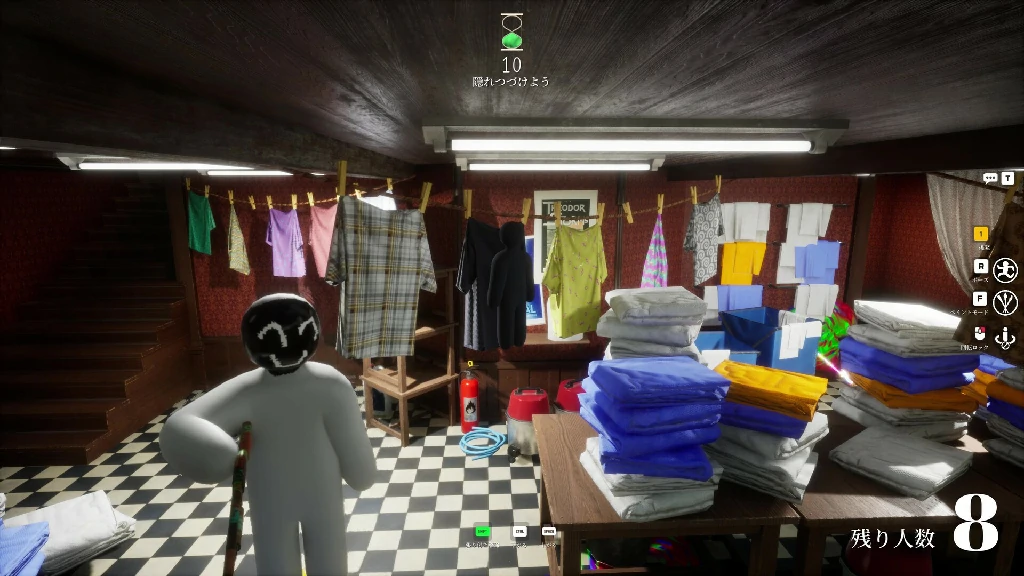
During the hunting phase, your goal is to find every hider before the timer runs out. That sounds simple, but MECCHA CHAMELEON changes the equation: hiders do not always hide in unreachable places. They often hide in plain sight, painted to blend into the environment.
That means the hunter’s challenge is not really "finding" people. It is recognizing anomalies. A hider may be standing on the wall right in front of you, painted almost the same color. If you look closely enough, their silhouette, posture, or placement will give them away.
Good hunters do not rely on color. They rely on reading the environment as a whole.
2. Build a Systematic Search Mindset
MECCHA CHAMELEON is not a parkour game. The faster you move, the more likely you are to miss someone hiding right in front of you. The most effective hunters develop a consistent search rhythm.
Do Not Run Randomly
Running aimlessly makes you pass through the same area repeatedly while barely checking others. Time is the hunter’s worst enemy. Before entering any area, decide what you are going to cover, and finish it before you leave.
Suspect, Verify, Then Move
When you see something suspicious, do not sprint toward it. Change your angle and confirm first. Then decide whether to shoot. Many hiders bait hunters into rushing past them or wasting shots on decoys. A calm hunter catches more people.
Balance Speed and Thoroughness
You cannot perfectly check every corner. Smart hunters balance "fast enough" with "careful enough." Slow down in high-probability areas, and move quickly through space you have already cleared or that has low hiding potential.
3. Color Lies. Shape Does Not.
This is the most important mental shift for hunters.
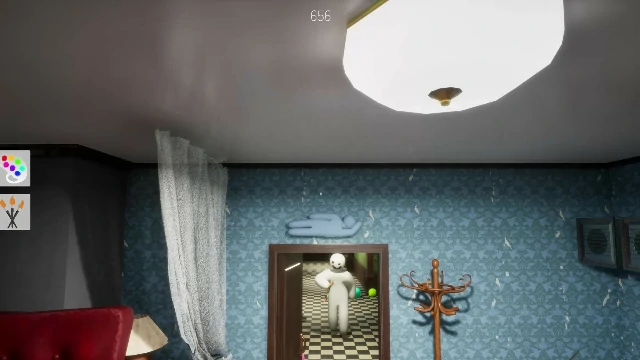
Experienced hiders can use the Eyedropper tool to match their body color almost perfectly to the environment. If you rely only on color differences, skilled players will walk right past you. What actually gives hiders away is shape, silhouette, and posture.
What to Look For
- Unnatural bumps: A surface that suddenly protrudes where it should be flat.
- Human outlines: Heads, arms, legs, and torsos are hard to fully hide even when the color matches.
- Objects that do not belong: A shape or object that looks wrong for its location.
- Inconsistent shadows: A body casts small shadows on the ground or wall that do not match the surroundings.
How to Train Your Eye
While playing, deliberately tell yourself: "Do not look at color. Look at silhouette." At first this will slow you down, but over time it becomes instinct. You will start noticing when something "looks like a person" even if the colors match perfectly.
4. Check High and Low
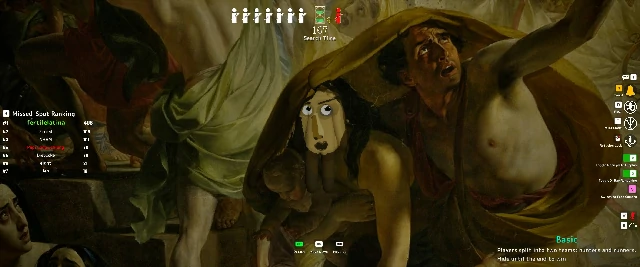
Many hunters only search at eye level. This is the single biggest weakness hiders exploit.
High Spots
- Ceiling lips and beams
- Above signs and doorways
- Rooftops and ladder tops
- Second-floor railings
- Cloud areas in bright maps
- Decorative roof elements
Most players, especially under pressure, do not look up. High spots are often safe because a hunter’s gaze instinctively stays on the ground and walls.
Low Spots
- Floors and carpets
- Under shelves and furniture
- Corners and baseboards
- Gaps and thresholds
- Shadowed floor areas
Hiders using the Lying Flat or Curl-Up poses can turn themselves into a colored patch on the ground. If you only stand and look, they are nearly invisible. Crouch or shift your camera angle to confirm low spots.
Build the Habit
Every time you enter an area, scan high first, then eye level, then low. This simple habit prevents you from missing the two most common hiding verticals.
5. Priority Areas: Corners, Clutter, and Open Spaces
Some locations are naturally better for hiding. Hunters should treat them as high-priority.
Corners and Gaps
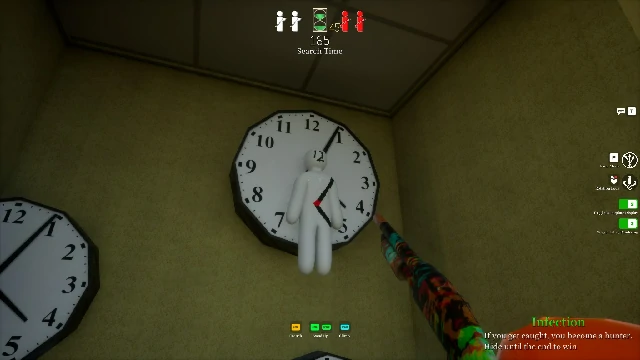
Corners are the most basic and effective hiding spots. A hider pressed against a wall, sofa, or cabinet only needs to match one visible surface to become hard to spot. Do not just walk past corners. Stop and confirm whether there is a silhouette or bump.
Cluttered Areas
Kitchens, party halls, storage rooms, trash piles, and decoration-heavy rooms are full of visual noise. Hiders blend into the chaos. Search these areas slowly and check each suspicious object individually.
Shadowed Areas
Shadows reduce color differences and hide outlines. Maps like Sewer and Backrooms are especially shadow-heavy. When you enter a dark area, get closer. Long-range scanning is not enough.
Open Spaces
This is where many hunters fail. Some hiders exploit the assumption that "no one would hide right out in the open." They may stand in a simple corner, beside a hallway prop, or even in the middle of a large room. Every open area deserves at least one careful scan.
Common Hiding Location Checklist
- Tight corners and wall edges
- Behind or between furniture
- Ceiling beams and lips
- Signs and rooftop edges
- Floors and carpets
- Clutter and prop piles
- Shadows and dark corners
- "Obvious" open spaces
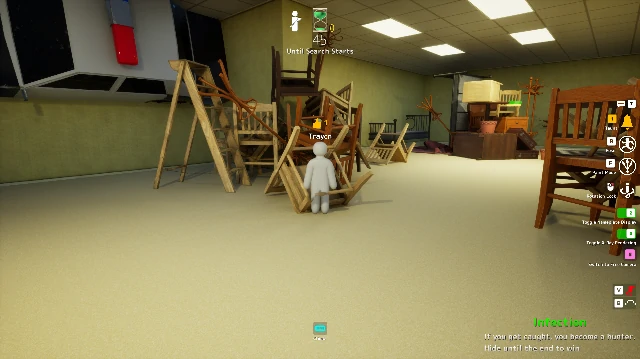
6. Systematic Search: Clear One Area Before You Leave
The most efficient way to hunt is to clear an area completely before moving on. Backtracking wastes time and gives hiders a chance to relocate or re-hide.
Recommended Search Flow
- Define the area: Decide that you are checking this room, hallway, or plaza.
- Quick scan: Look high, mid, and low. Identify the most suspicious targets.
- Close inspection: Change angles on suspicious objects. Move closer or test with a shot if needed.
- Move on: Only leave after you have done a reasonable pass. Even if it feels empty, finish the check.
Why Systematic Searching Works
Many hiders are not perfectly hidden. They survive because hunters rush. A methodical hunter who checks every zone once will catch more people than a fast hunter who half-checks every zone twice.
Confirm From Multiple Angles
One angle can make a hider invisible. Another angle can expose them completely. This is especially true for low spots, gaps, and partially hidden positions. If something looks almost suspicious, move and look again.
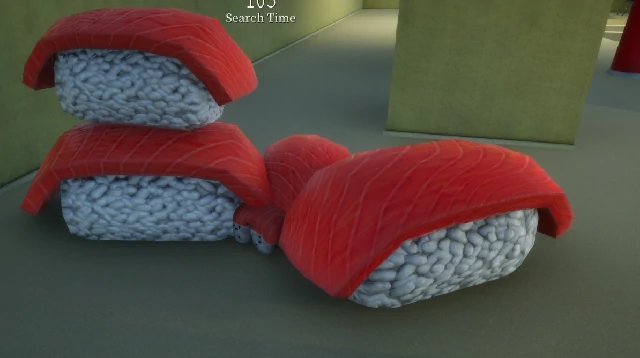
7. Use Sound, Clones, and Mode Mechanics
Hunting is not just visual. The game gives you tools and information that can narrow your search.
Use Forced Taunt
Forced Taunt is a lobby setting that makes all hiders automatically whistle at set intervals. The sound reveals the general direction of hiders but not their exact position.
When you hear a taunt:
- Identify the direction of the sound.
- Move toward that area but do not sprint into the most obvious spot.
- Be aware that some hiders use the taunt as cover to relocate.
Watch for Late Movement
Many hiders move when they think you are not looking. After a taunt, when you are turning away, or when you enter a new area, keep your peripheral vision active. If you catch movement, turn back immediately.
Dealing With Clones
Clones are one of the strongest tools advanced hiders have. By pressing Q, a hider can create a copy of themselves. They can have up to two clones active at once, plus their real body, for a total of three potential targets.
As a hunter, remember:
- Shooting any clone eliminates the hider who created it.
- Clones copy the hider’s pose and color, so they may float in the air or appear in strange positions.
- More clones mean more targets, but also more chances to hit one by accident.
If you see multiple suspicious targets, prioritize the most unusual one. Floating objects, oddly placed objects, or overlapping shapes are likely clones.
Hunter Strategy by Mode
| Mode | Hunter Strategy |
|---|---|
| Basic | Hunters are a separate team. Split up to cover more ground. |
| Infection | Found hiders become hunters. The hunter count grows. Prioritize finding the last hiders before time runs out. |
| Double | Everyone starts as a hider, then becomes a hunter. Expect advanced techniques, including clones, from everyone. |

8. How Filters Change Hunting
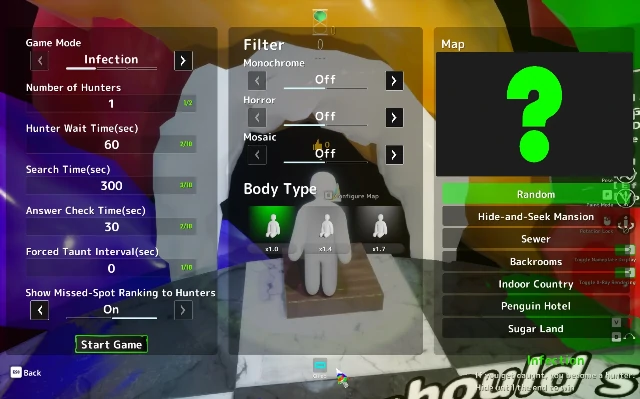
The host can apply filters that alter the visual presentation of the map. These filters change what you should prioritize while searching.
| Filter | Effect | Hunting Impact |
|---|---|---|
| Monochrome | Removes color information | You cannot rely on color differences. Shape and silhouette become everything. |
| Horror | Enhances highlights and shadows | Shadow areas become harder to read, but outlines may become more dramatic. |
| Mosaic | Pixelates the view | Details blur together. Long-range spotting is harder, but close-up blocky anomalies may stand out. |
Mixed filters make searching harder. If the lobby has multiple filters active, slow down and confirm suspicious objects from close range.
9. Common Hunter Mistakes
- Relying only on color: Skilled hiders can match colors perfectly. Shape is the real tell.
- Moving too fast: Speed makes you miss obvious anomalies.
- Only looking at eye level: High and low spots are where most hiders live.
- Backtracking without clearing: You waste time by revisiting half-checked areas.
- Ignoring open spaces: The most obvious place is sometimes the safest.
- Shooting on impulse: Firing at a suspicious object without confirming wastes time and can give hiders information.
- Chasing clones: Running after a decoy can pull you away from the real hider.
- Not learning from losses: If a hider escapes you, remember where they were. They may use the same idea again.
10. FAQ
Should I focus on color or shape?
Shape. Color can be matched almost perfectly with the Eyedropper, but human silhouettes and poses are much harder to hide.
Why do I never find anyone?
You are probably moving too fast, only scanning at eye level, or passing through areas without really checking them. Slow down and scan vertically.
What should I do when a taunt happens?
Identify the direction of the sound, move toward that area, but do not charge straight at the most obvious hiding spot. Some hiders will relocate during the taunt.
How do I handle clones?
Shooting any clone eliminates the hider who made it. Prioritize unusual, floating, or overlapping objects.
What about cluttered rooms?
Slow down and check each suspicious object individually. Clutter is one of the best places for hiders to hide.
Are high spots really worth checking?
Yes. Most hunters do not look up, so ceiling beams, signs, and rooftops are common hiding spots.
How does hunter strategy change by mode?
In Basic mode, split coverage. In Infection mode, the hunter team grows, so focus on the final hiders. In Double mode, everyone is a potential hunter, so expect advanced techniques.
11. Where to Go Next
- Want to understand the other side? Read the Hider Guide.
- Need map-specific hiding and seeking spots? Read the Maps and Hiding Spots Guide.
- Want to understand lobbies, modes, and filters? Read the Game Modes and Lobby Settings Guide.
- Want to understand clones, poses, and the Missed Point Ranking? Read the Mechanics Explained Guide.
Where to go next